
USACE along with federal, state and local officials celebrated completion of the contract inflow and outflow canals for the EAA reservoir …
Join our family of readers for as little as $10 per month and support local, unbiased journalism.
Already have an account? Log in to continue. Otherwise, follow the link below to join.
Please log in to continue |
![Leaders from the U.S. Army Corps of Engineers Jacksonville District, Florida Department of Environmental Protection, and the South Florida Water Management District cut the ribbon Sept. 23 to celebrate completion of Contract 10A of the Everglades Agricultural Area Reservoir Project. [Photo courtesy USACE]](https://eta.creativecirclecdn.com/scfl/original/20250924-144949-e98-ribbon%20cuttline%20jpg.jpg)
U.S. Army Corps of Engineers (USACE) along with federal, state and local officials celebrated completion of the contract inflow and outflow canals for the Everglades Agricultural Area (EAA) project on Sept. 23.
Col. Brandon Bowman said the 8.3 miles of inflow and outflow canals are “the quiet work that makes the whole reservoir function.”
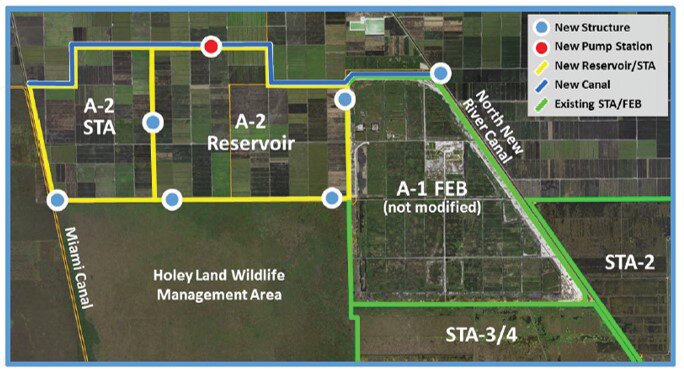
The 10,500-acre EAA reservoir, expected to be complete in 2029, will hold up to 240,000-acre feet of water (the equivalent of about 6 inches on Lake Okeechobee). During periods of heavy rainfall, excess water from Lake O will flow into the reservoir. As capacity is available, water from the reservoir will flow into the accompanying A-2 Stormwater Treatment Area (STA) where it will be cleaned before release south to Everglades National Park and Florida Bay. Depending on conditions, the reservoir and STA could store and treat up to 370,000 acre feet of water a year.
South Florida Water Management District (SFWMD) Executive Director Drew Bartlett said the expanded canal system has the capacity to take the volume of water coming into Lake O from the Kissimmee River.
“From reservoir and stormwater treatment construction to levee removals and canal backfilling, each piece of this massive effort contributes to the larger vision: restoring balance to Florida’s water system,” said Connor Tomlinson, Special Assistant to the Assistant Secretary of the Army for Civil Works,
Construction of the A-2 STA, a 6,500-acre man-made wetland, was completed last year. John Mitnik of the South Florida Water Management District (SFWMD) said native vegetation is growing in the STA. Sufficient water from Lake O is flowing in to hydrate the area. He said a few areas were planted with native vegetation to create a break in wave action from the wind, but most vegetation comes from natural recruitment. After the plants grow in, the STA should be ready to accept water. Until the EAA reservoir is complete, water will flow directly from Lake O to the STA to be cleaned and released south to Everglades National Park.
He said they focus on native vegetation and use herbicides to kill invasive vegetation in the STA if necessary.
The EAA reservoir and A-2 STA are part of the Central Everglades Protection Plan (CEPP), a component in the Comprehensive Everglades Restoration Plan (CERP). CERP, the largest ecosystem restoration effort in American history, was authorized by Congress in 2000. CERP is a federal-state partnership.