

In June 2025, Florida officials unveiled plans for an immigration detention facility on an abandoned airstrip deep in the Big Cypress National Preserve...
Join our family of readers for as little as $10 per month and support local, unbiased journalism.
Already have an account? Log in to continue. Otherwise, follow the link below to join.
Please log in to continue |
U.S. Representative Maxwell Frost described the population of the facility dropping from 1,400 detainees to roughly 655 in only a few weeks in May, with no new detainees arriving. Existing detainees were being transferred elsewhere, mostly to a processing center in Louisiana, based on FlightAware data showing roughly a dozen flights leaving the site in a single week.
State and federal officials have stopped short of confirming a full closure. Gov. Ron DeSantis has maintained that the facility was always meant to be temporary, built without permanent infrastructure specifically because it was designed to fill a gap while the federal government lacked sufficient detention capacity. He has credited the operation with helping process and deport around 22,000 people and said he would welcome the state stepping back entirely if federal resources made the facility unnecessary.
The facility opened on July 2, 2025, with President Trump visiting and praising it the day before. Run by the Florida Division of Emergency Management in coordination with ICE, it was built to hold 3,000 or more detainees, though estimates of its capacity shifted across various reports.
Alligator Alcatraz received pushback almost immediately after it was announced. On June 28, as construction of the facility was underway ahead of the July opening, hundreds of people lined the sides of the Tamiami Trail in opposition to the project. The rallies against the project have been led by Native Americans, including the Miccosukee Tribe who call the Big Cypress home. The site is only a few miles from the nearest Miccosukee camp.
![Betty Osceola of the Miccosukee Tribe of Indians of Florida orgainzed the protest against Alligator Alcatraz. [Photo by Richard Marion/Lake Okeechobee News]](https://eta.creativecirclecdn.com/scfl/original/20260616-130156-ca4-Alligator%20Alcatraz-1.jpg)
The project also received opposition from those who worried about the costs of maintaining the facility, arguing there were more cost-efficient sites for a detention center that would not impact the environmentally sensitive Everglades. Cost estimates put the facility's annual operating budget at roughly $450 million, with private vendors charging about $245 per detainee per day.
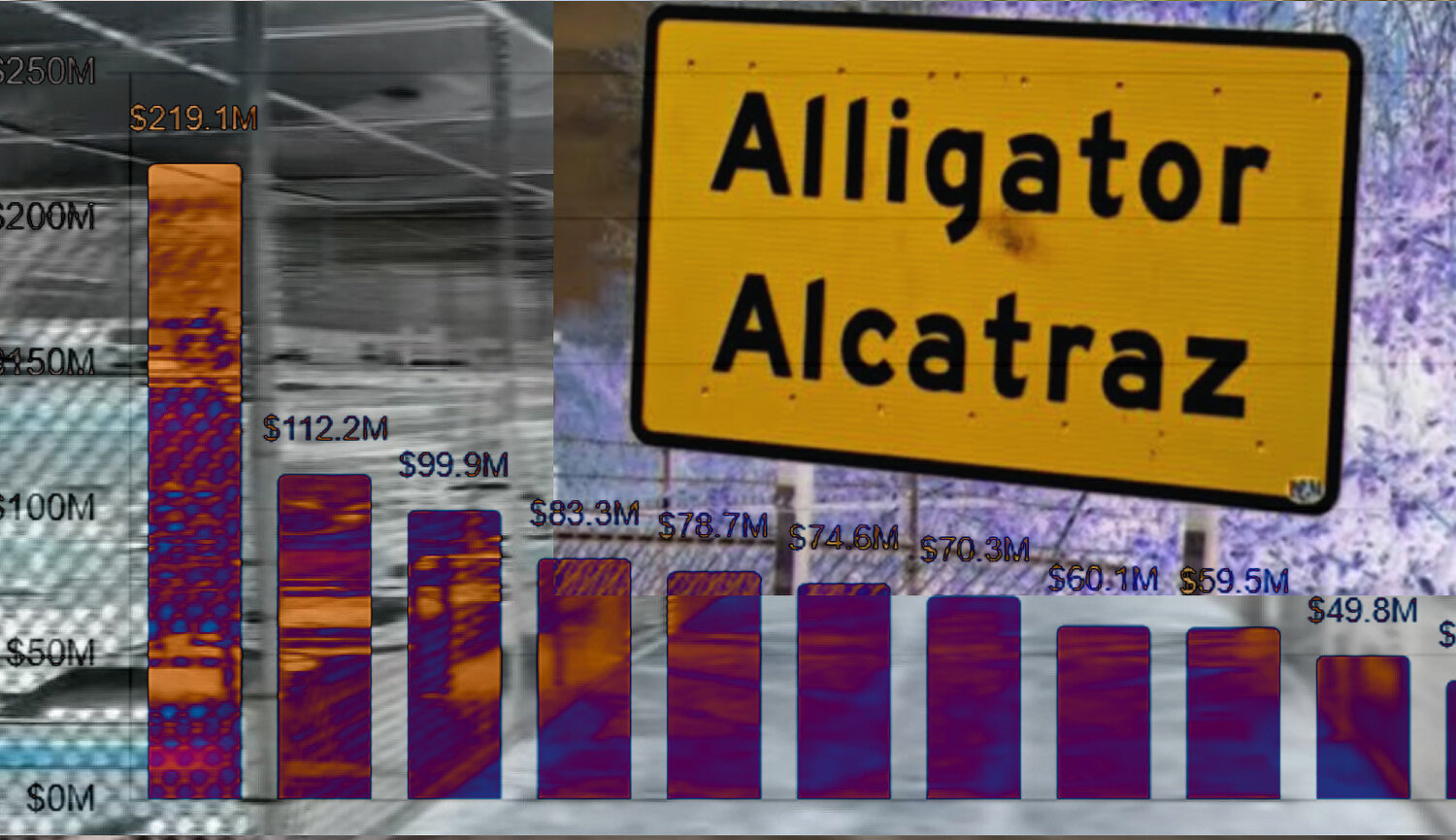
Records released thanks to a lawsuit brought by the advocacy group Friends of the Everglades show the Florida Division of Emergency Management formally requested a $1.49 billion federal grant in August 2025. During the facility's earliest weeks, the "daily burn" rate to support around 500 detainees topped $3 million a day, and even months later it was running above $1.2 million daily.
![[Photo by Richard Marion/Lake Okeechobee News]](https://eta.creativecirclecdn.com/scfl/original/20260616-130235-623-Alligator%20Alcatraz-6.jpg)
A single portable-restroom contractor, named Doodie Calls, was paid more than $92 million to manage the roughly 45,000 gallons of wastewater the camp produces every day. Other line items ranged from $39,000 for staff pillows to nearly $170,000 for wide-brimmed "boonie hats." The facility's warden was paid $1,000 a day, more than $365,000 a year before overtime, while corrections officers at Alligator Alcatraz earned base salaries nearly three times what officers make in other Florida prisons.

Who ultimately will be responsible for those costs has been up in the air.
Gov. DeSantis told the public early on that the federal government would cover the cost. In October 2025, he celebrated a $608 million reimbursement award from the Department of Homeland Security. But by early 2026, no reimbursement had materialized, and attorneys representing the state began acknowledging in court filings that the money might never come, conceding that Florida had built and run the facility on its own, without federal input.
For now, vendor contracts are being paid through a governor-managed emergency fund created by the state after the covid pandemic.


